


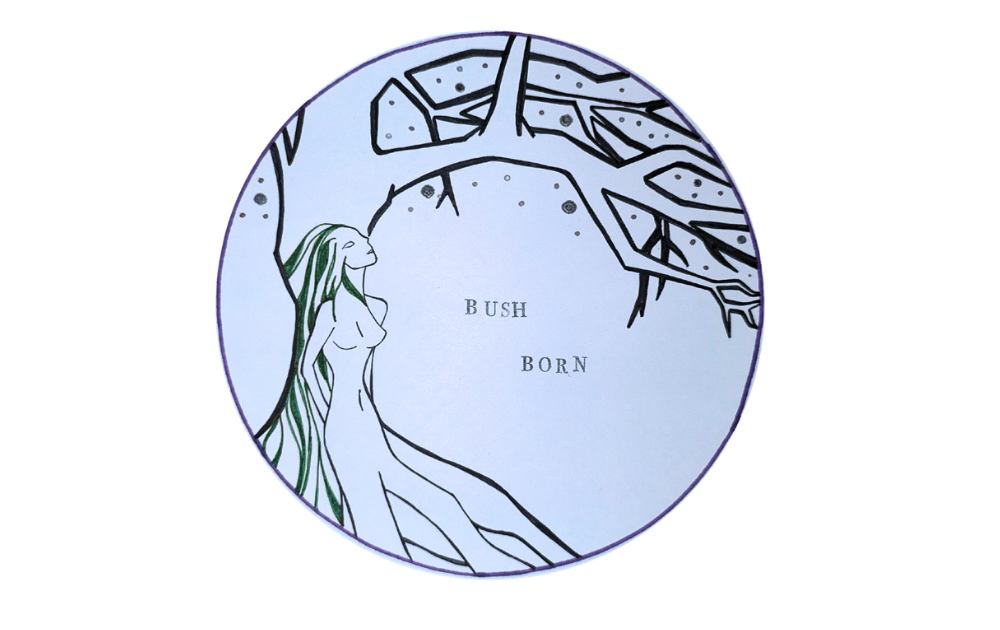
Sabine lay in a clearing in wild bushland which glittered with the light of a million stars. Night had dawned some hours ago, and it was especially dark because her heart had stopped.
Her eyes stared blankly at the sky, dead pools reflecting the moonlight back into the trees above. Her neck, long and graceful as a swan’s, had been stained by someone’s brutish fingers, and her beautiful face was marred black and blue and bloody. The blood soaking into the ground to be drunk by roots, who wept for the loss of Sabine, known to them since her childhood.
Only last week she had repaired a bird’s wing before she returned him to the wild, and the afternoon of her death she had crushed eucalyptus leaves in her hands so that the scent would stay with her.
Sabine hadn’t expected to die. Death itself was not something she’d ever been afraid of, although she’d spent her short life deeply wary of the method (as only a woman can be). Yet she found herself surprised, both at the fact she was dead, and that this was to be her final resting place.
In this space between worlds, Sabine looked upon her body, beloved vessel that had carried her, and felt a fury she’d never experienced, for it was without flesh to contain it.
Failing a mind to give the illusion of structure her memories burst forth into the present and became present, and she experienced them again as if it were the first time, though this time underpinned by a crackling, burning rage.
She was a child, crouched by the pond and giggling at the sight of a toad in her hand. She was a teenager, brushing her hand against bark, sleeping in the sunshine for so many hours that she woke dizzy. 16 and she began to take lovers into the bushland, first for kisses then for more.
Her death had been violent although she had never been, and it had been unfair although she’d striven all her existence to be kind and gentle. Worse, it had been a betrayal of trust by someone she’d considered a friend, or to have shared humanity with at the least.
And all around the creatures of the bush whispered, the crickets and the cicadas and the birds and the trees, all in mourning for her, for the fact that her soul had been so callously cut from her body.
“Do something!” she screamed at them, although she had no mouth to voice her thoughts. “Help me, please.”
But she was dead, and she was so deep in the land that no-one would find her in time to pump her heart back to life…maybe no-one would ever find her.
“This can’t be it,” she said, begging now. “I am Sabine. I am me, myself…I’m not ready to die. I have things to do. I cannot go.”
In the dark of this very dark night, Sabine was still lit like a flame and her fury expanded with every moment that passed. It was felt by anything in her near vicinity, and because she was spirit creature without skin, her despair was a fume, sinking into the flora and fauna.
She looked upon herself and saw that nature had started to claim her despite her pleas. White hot emotion burned her, building up until it was her and she was everything she’d always been and now this new thing too, this hissing, sizzling, popping thing, without form, without expression, and in such a state of pure anguish that the bushland wept.
Again, she disappeared into her memories, saw herself healing a broken sapling with sticky tape, watched herself watch the trees swaying to the breeze, then swimming in the creek, then listening to the birds – kookaburra, currawong, crow, magpie, all.
“You must do something!” she demanded of her friends. “This body is mine and I will not let it go. I cannot yet let it go. Not yet.” If she still had bones she would’ve felt deep within them that she was not finished on this earthly plane. “You must help me,” she implored, and with that, she gathered herself, this new scorching, beautiful, raging part of her too, and held onto her cold body with all her will.
But her body had already started to go the way of things, and so, in a language not known (or long ago lost) to mankind, the beings of the bush began to discuss what it was that they could do, for even the stars above could not help but be affected by Sabine.
A red sliver of first light broke on the horizon as a decision was made.
Slowly, she sat up, and discovered that she was no longer human. Yet she also was not made only of spirit, for she again had flesh to adorn her. And if she’d loved the bush before, she felt it now inside her chest, within her veins, even her eyes and mouth. Her heart did not beat, and her lungs did not move the way they once had, but she found that she was alive in the way that the trees are, or flowers, or thorns.
The roots that had drunk of her blood had buried themselves inside her, given life to her again, and her eyes weren’t alive but they shone with a new life. She heard the birds as she always had and understood them now as if they were one and the same.
Sabine, newborn from the womb of the earth, touched her hands to the ground and kissed it. “Thank you,” she murmured, voice now changed from death. Once dulcet, her tone had a gravely rasp to it, like bark peeling from a gum tree.
She looked around at the wild bushland which had given itself to her, had taken her for itself. Less than 10 hours ago, she had been a young woman brutally ripped from all she loved. But that was in another life. The early morning light shone down, and Sabine turned towards it as the trees did, her face part human, part nature, all new. “I will protect what is mine,” she promised. “I am myself and more, and I still have things to do.”
Author Bio
Victoria is the Marketing Director and Fiction Editor of Mindfork. She studied Journalism in her homeland Australia and is currently working towards her Masters in Creative Writing. She was awarded Penguin Australia's Write It Fellowship for her novel 'Esther' and has had her novellas, poetry and articles published in Australia and England. She frequently participates in literary workshops in London and Europe and is currently working on a new novel.
Yours in treachery,
Fiction Editor


The opening is so stark, and the way the bush becomes witness, mourner, and finally collaborator gives the whole piece a mythic force without losing the human grief at its centre. I especially admired how controlled the prose feels even while the story moves through rage, tenderness, and transformation. It’s brutal, beautiful work.