

Sulpicia, even more so than the male Latin poets, must be ambiguous. That is all I really know about her despite the countless times and ways I’ve translated her six surviving poems—the only six surviving poems we have by a Latin female poet. Her poems weren’t even published as her own, but as part of Tibullus’ corpus—and how are we to know that what he was saying with her words is the same as what she was?
*
A few days ago, Lila sent me a picture of a memorial plaque that read:
For Jackie
My Lifelong Best Friend
From Janice
We Were Girls Together
*
My hated birthday is here, which is to be spent—
in the irritating countryside and miserable without Cerinthus.
*
I knew who would say ‘happy birthday’ to me. Dad and Rylie, my grandparents and cousins, and Lila, Rose and Kristy. Sam would. Jake would not. He was once my second closest friend, but I became too much for him—draining, frustrating, a hinderance to his life. I’ve always felt too strongly. Jake ended our friendship on February 14th. I still said ‘happy birthday’ to him in May, but he won’t say it back.
When Jake ended our friendship, the pain was unbearable. It was worse than when Mum died. I feel terrible admitting that. I know I could never have a friendship again like I had with Jake. With Lila it’s different. That friendship is easy. But everyone else will leave eventually.
*
Ever since Mum died, I’ve been reminded that I would be a disappointment to her. Bà Ngoại cries a lot and tells me Mum would be so sad that I don’t dress nicely, so disappointed that I can’t break my systems to make everyone else happy. I suggested once a vague hope that Mum would have come to understand, but that made my grandmother cry harder.
‘You say you don’t want to make your mummy happy.’
I said I miss her smile—seeing it always made me smile too. Then we were both crying.
*
Lila called me earlier to say happy birthday. Sam had told her I’d had another breakdown and asked her to check in. He will probably now forever associate sausage rolls and milkshakes with the futile effort of trying to mitigate my spirals. I feel so bad.
‘Yeah, but you feel bad for everything,’ Lila said. I could feel her eye-roll like a weak balm.
*
I tried to blow up a balloon this morning. I chose a purple one and I was going to draw a face on it—one that was happy. I would throw it up into the air and watch the smile slowly come back down to me.
My breath inflated it to a small bulge the size of a lightbulb and it refused to grow any bigger no matter how hard I puffed. I gave up and let go and the bulb puttered out in one quick exhale.
*
When Sam agreed to hang out with me this afternoon I could tell he didn’t really want to, but I said ‘Okay’ anyway. It was a selfish response when I knew how draining I was to him. I should have given him some way of getting out of hanging out with me on my birthday that wouldn’t make him feel bad. I knew he didn’t want to hurt me. Yet, I still said ‘Okay’. I’ll take the three hours of his time, because that’s what I do. I take and take and give nothing back. Selfishness is my nature.
*
My unseen birthday is here, which, in the irritating countryside—
and miserable without Cerinthus—is to be spent.
What is sweeter than a city? Or is a villa all there is for a girl—
and a freezing river in an Arretian field?
*
Bà Ngoại hugged me and there was nothing I could do about it. She had lost her daughter, and I was the closest thing she had left to her. She squeezed and my muscles squeezed with her, tensing in on themselves in an attempt to burrow away from that enclosing, all-encompassing embrace. She was wearing perfume. I know now what it is to feel safe in the arms of another person. Perhaps it is a betrayal to my family, to my mother’s memory, that it is not my grandmother’s arms that are my safe space.
I asked Lila if it bothered her that she could never hug me now that Sam could. She said it didn’t. He could be close to me physically, but she could be close to me in our thoughts, in our past, in our conversations.
‘There are things that are more me than my body.’
*
Dad says translation is all I ever do. Last year, he told me I was being selfish by studying too much. I was shaken because studying was the only way I knew how to make my family happy, and if even that was selfish then everything I did was. I asked why, and he told me I wasn’t making time for friends or family. He asked me how I would feel if Bà Ngoại or Ông Ngoại were to die and I hadn’t seen them in months. That thought hadn’t crossed my mind—I lose myself in a dead language, knowing theirs is a living one I barely understand. I asked Dad why he thought they were going to die that year. He said he didn’t think they would, but it was always a possibility.
‘But that’s not the point anyway,’ Dad added. ‘The point is it’s upsetting to them that they don’t get to see you because you’re always too busy studying.’
I’ve known since then that I would always hurt everyone who loved me.
*
‘What are you doing tonight?’ I tried to ask it casually, but it felt like it was breaking from me without my control. It didn’t matter. He said another friend was having a party and I should have left it there.
He was going clubbing. Of all the things it could have been, that is the worst. A club is somewhere I can never go. A club is a side of him I can never know. I can never truly know anyone. There is a chasm and no bridge—there can never be a bridge—and I can see them on the other side—I can feel them from the other side—but I can never reach them.
*
Lila asked me how I had been sleeping recently. She had never slept well in her life, but she knew my mood was affected if my sleep was. Maybe I shouldn’t be translating Sulpicia again right now. I told her my sleep had not been great.
‘The same dream again?’ she asked. I had described the dream to Lila before—the wave, the silence, the chains. I’d described waking up mid-thrash, sweating and exhausted and unable to go back to sleep for hours. I would kick at my blankets; claw at my skin; try to get out but only ever sink further into the spiral.
Lila had told me before to message her when I woke up from the dream. She pointed out that she would probably still be awake. But—I didn’t want to darken her nights as well. I told her so when she confronted me about not messaging her.
‘Bella, I guarantee you, talking to you would darken my nights a lot less than sitting here thinking you might be trying to claw your fucking skin off.’
*
My phone flashes with a notification. Sam’s posted. I click it open and flick through the ten photos. Wine glasses at various stages of empty. Cheeks pressed to cheeks creased with smiles. Vague blurs of lights and movement. There is an energy to him. He looks happy. He’s alive.
When Jake and I were friends, he made me part of everything. If I couldn’t be part of it in person, he would message me about it as soon as he got home because he wanted to share every aspect of his life with me. I knew him. Every day I knew him. Now I don’t know him at all. Intimacy putters out in one quick exhale the moment you run out of breath. I’ve never been very good at breathing.
*
My birthday is here—unseen—which, in the irritating countryside
and without Cerinthus—miserable!—is to be spent.
What is sweeter than the city? Or is a villa fit for a girl—
and a freezing river in a field of Arretium?
Oh Messalla—rest, you care too much for me—
gods damn me! It’s a seasonable journey.
*
Sam said he wished I could be grateful for the time he could give me instead of being disappointed that he couldn’t give more. I am grateful for it. I’ve never been good at expressing gratitude but I feel it like a steamroller every day. I tried to tell him that and he said he knew.
‘I just wish you didn’t get so disappointed because it does affect me.’
I said I’m sorry. He didn’t respond and I felt as frozen as I am in my dreams. I could hear his response in my head. You say sorry, but the same thing happensevery time.
*
The Latin poets never rhymed. Though I’m looking at the last two lines of Sulpicia’s genethliacon—
Hic animum sensusque meos abducta relinquo,
             arbitrio quamvis non sinis esse meo.
—and oh.
I repeat them to myself and wonder how they never sounded like that before.
*
In my head we’re dancing. On the beach in the kitchen. Our bodies move in awkward unison, limbs clashing torsos swaying—closer. Closer—as we scream the lyrics to the bubble of night sky around us—You got all my love.
*
‘Apta’ means appropriate, suitable. It’s where we get the word ‘apt’ from. Maybe the isolated villa is fit for the girl because she would only hurt Cerinthus if she stayed with him. Maybe Messalla was not oppressing her, but simply cared too much for her—‘studiose’ after all, connotes an interest, a devotedness. ‘Quiescas’ is literally ‘please rest’. Maybe she knows that she is draining him. Of course, I don’t think this is really what Sulpicia meant, but it’s comforting to consider that maybe it’s not just me.
* He will leave. He will end our friendship like Jake did for the sake of his own wellbeing and Sulpicia couldn’t go a day without Cerinthus. I couldn’t blame him for it. I can’t. Imagining losing him—imagining living my life without him—is impossible. Trying is delving into a pain so agonising I have to turn back immediately or I will simply die.
*
My birthday is here—invisible!—which, in the wretched country
and without Cerinthus—miserable!—is to be spent.
What is sweeter than the city? Or is a villa fit for the girl—
and a freezing river in a field of Arretium?
Oh Messalla, you care too much for me—rest—
gods damn—the journey—it’s seasonable!
Here my spirit and capacity to feel—abducted—I leave
however—you don’t allow—the power—to be mine.
*
But I could never kill myself. That would be too selfish—too painful for everyone who loves me. For Dad, for Rylie, for Lila, that would be as unbearable as losing Sam would be for me. I couldn’t put them through that kind of grief. Unless there were some way that I could kill myself without them knowing. Perhaps—if I moved away to the other side of the world where they would very rarely be able to visit? I could travel around a bit and find somewhere to settle. I’d write a letter home saying I had found a place and was well. Tell them about my travels. Tell them I loved them. Tell them I hadn’t set up wifi in the place yet and so probably wouldn’t be able to contact them for a while. Once I had been away for some time with minimal contact they would have gotten used to me not being in their lives without realising I wasn’t anymore. Then I could find a waterfall to die in. I’ve always wanted to have my ashes spread at a waterfall like Mum—I would have to die at one so that my body could stay there. I would have to find a waterfall where I could die without someone finding me though. One no one could ever get to the top of because it would be impossible to do without dying. I would do it and I would die and no one would find me. Maybe no one would even realise I was gone. They could go on with their lives in ignorance and be happy without the burden of loving me.
*
The Latin poets were bound by a strict rhythm. Sulpicia uses elegiac meter. This poem is a mouthful, but it scans.
I am not a Latin poet.
*
Bà Ngoại said when we dream of Mum it is her spirit visiting us—her way of being with us still. Rylie dreams of her almost every night. I haven’t dreamt of her in years. She didn’t come on my seventeenth birthday. She left me alone on my eighteenth. Bà Ngoại says this is because I never needed her as much as Rylie did. What kind of person doesn’t need their mother? I hope she comes tonight. I hope she tells me she loves me no matter what I wear, where I look, how I love. I hope she says she is proud of me simply for being me. What kind of mother is proud of a person whose most selfless act is their own self-preservation? I hope she doesn’t come tonight.
*
Perhaps it was through love that Messalla did not allow Sulpicia arbitrium—judgement, thought, control—power. ‘Relinquo’ is where we get the word ‘relinquish’. She wants to give up her animus, her sensus—her mind and feelings, her courage and senses. But ‘animus’ can also mean ‘spirit’. She wants to give up her spirit and capacity to feel. It is love that prevents one from doing that. She may have lost her parents, but perhaps she was still loved. When I read the poem like that it feels laced with gratitude rather than resentment.
As oppressive as he may have been, Messalla is the reason Sulpicia’s poems survive in the small capacity that they do. As Tibullus’ patron, he would have decided to include her poems in his book, despite the tyrant she seems to portray him as—he is the reason she still has a voice millennia later.
That’s what love does, I suppose. It gives us a different power—the power to survive.
*
Lila says I’m the least selfish person she knows; that no one else thinks I’m selfish. That’s simply not true though. Dad said I was selfish for studying too much and for not breaking my system on the anniversary of Mum’s death and for not wanting to wear makeup at my aunty’s wedding. Bà Ngoại said I was selfish for saying she shouldn’t use dầu on planes and that I don’t like small talk and for not wanting to go clothes shopping with her. Mum used to say I was selfish for always wanting people to follow established rules in games and for covering my nose when talking to someone if there was a bad smell and for not dressing the way she wanted me to and—
I need to stop. Lila says none of those things are selfish because I do most of them to avoid distress. But I should be able to deal with it to make the people who love me happy. I should be able to—
Lila says those things are not worth it. She says if makeup felt to my family how it does to me, they wouldn’t want to wear it either; if certain smells gave them a throbbing headache, they would also try to avoid them. She says the happiness they would get from seeing me in a dress more often wouldn’t come close to the distress I feel when I break my clothes system.
‘If they experienced the distress that you do,’ she told me, ‘they would not be able to fucking deal with it.’
*
I’ve decided Lila is probably right.
*
‘Hic animum sensusque meos abducta relinquo,
arbitrio quamvis non sinis esse meo.’
                                                                — Sulpicia 2.7–8

Si arbitrium esset meum,
Renideret ea, quamobrem?
Ob me! Nam facerem eam esse laetam!
Dicat quod dicit verbum meum!
Sed iam animadvertem ea verba.
Dicitne se esse tristem ea?
An me esse tristifica?
Suntne haec, Mater, verba tua?
*
‘Dicant quod dicunt verba nostra—’ It’s a whisper into the wool of my lamb’s head.
‘Verba matris meae—’ I breathe. ‘Et mea!’

Let our words say what they say—
The words of my mother—
                                                     And of me!
Author Bio
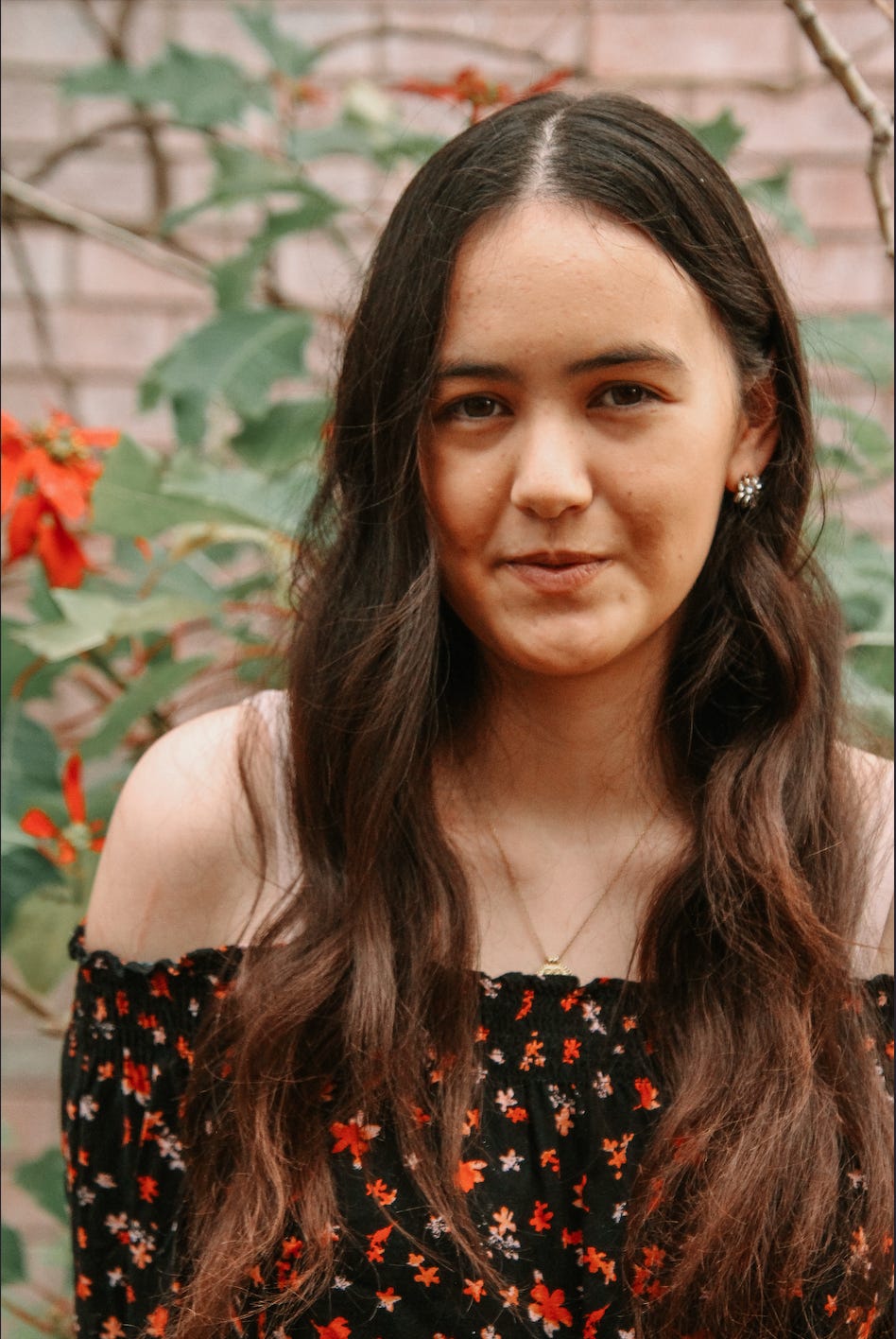
Kayla May Browne is an autistic writer living and writing on unceded Whadjuk Nyoongar Boodja. Her fifth novel, Dark Red, was highly commended by the Fogarty Literary Award in 2025. She is currently undertaking a PhD in creative writing at the University of Western Australia, focusing on representing diverse autistic voices, subjectivities and experiences in fiction.
See more of her work on her website: kaylamaybrowne.wordpress.com
Yours in treachery,
Fiction Editor


